Insights|30 Jul, 2026
Consider the Dividend
The Bank implemented a sub-class capital stock structure that provides the ability for members to declare a higher dividend rate on Activity-based stock versus Membership-based stock.

The Federal Reserve has shifted from signaling potential tightening to actively tightening policy, raising the federal funds rate by 25 basis points at its September 16, 2026, meeting to a target range of 3.75% to 4.00%. Chairman Kevin Warsh and the broader FOMC continue to view inflation as the primary policy concern, following hotter-than-expected August core inflation data and signs that price pressures may be broadening beyond tariffs and energy costs. The Committee's updated projections indicate growing support for additional tightening, with the median year-end 2026 rate forecast increasing to 4.1% and many policymakers anticipating at least one more rate hike before year-end. Despite political pressure for lower rates, the Fed characterized economic conditions as generally strong, citing robust productivity growth, solid capital investment, stable unemployment, and continued job gains, suggesting policymakers remain willing to prioritize inflation control even at the risk of further tightening financial conditions.
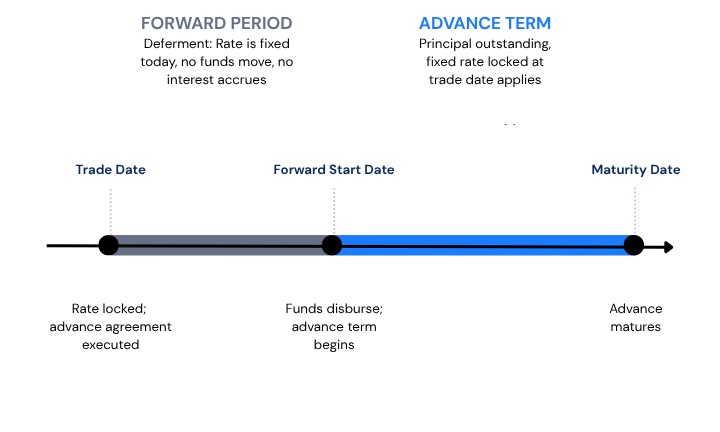
If you have upcoming liability maturities or loan conversions, or are managing a leveraged securities strategy and expect further interest rate increases, you can lock in a fixed borrowing rate today for funds to be drawn at a future date using the forward-starting feature on a Fixed Rate or Amortizing Advance. This feature helps to provide certainty around future funding costs without taking the cash immediately. The advance rate is fixed for the entire term and determined on the day of the request for the applicable term and commitment period, helping to protect against rising interest rates, manage future funding needs, and preserve net interest margin.
How the forward-starting feature works and the benefits it provides to your balance sheet
Interest rate considerations and implications
Detailed use case examples
ALCO, finance and your board can budget funding costs, NIM, and deposit pricing against a known future rate.
When the asset yield of liability replacement need is already visible, locking the funding leg protects the expected spread.
Amount, term, and timing can be aligned to known maturity, loan closing, investment settlement, or rollover date, resulting in increased planning precision.
Because principal is drawn and no interest accrues during the forward period, there is no early balance sheet drag, and you avoid negative carry on idle cash.
The forward-starting advance rate is derived from the spot advance curve, so the value proposition changes with curve shape and expected rate direction.
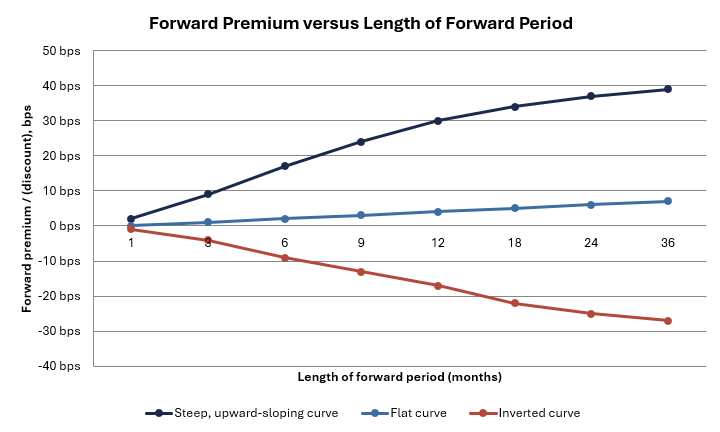
Chart 1. Hypothetical forward premium, not reflective of current market rates
Funding Known Liability Maturities (CD and Wholesale Funding Walls)
Retail CD portfolios and wholesale funding books both tend to mature in identifiable waves. When a member can see a large block of maturing, low-cost funding on the horizon and expects to replace it with new deposits, brokered CDs, or wholesale borrowing at a potentially higher cost — using the forward-starting feature lets the member lock the replacement cost today rather than face rate uncertainty on the maturity date.
Illustrative example
A credit union member has a $60 million block of share certificates maturing in 3 months. Management does not expect to retain the full balance at renewal and plans to fund the shortfall with a 1-year advance. Today's 1-year spot advance rate is 4.23%. A 3-month forward-starting, 1-year advance can be locked today at 4.28%, a 5-basis point forward premium.
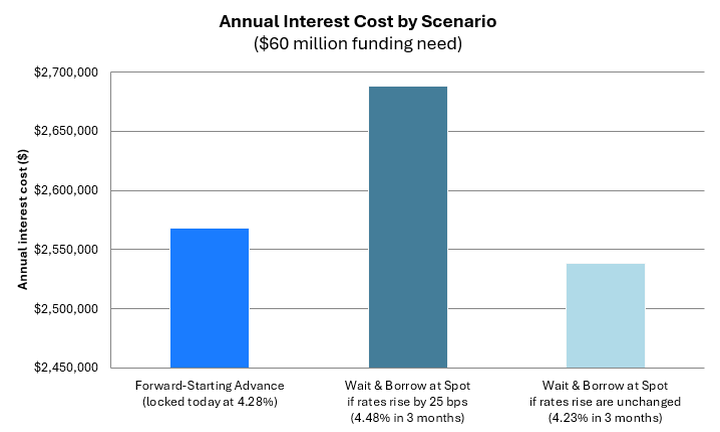
The decision reduces to a breakeven question: the forward-starting advance is the better outcome any time spot rates three months from now are above 4.28%. That is, any increase greater than the 5-basis point premium being paid today. If management's own outlook, or the market's own forward pricing, suggests a reasonable chance of more than 20 basis points of increase over that window, locking in a forward-starting advance removes that risk entirely for a modest, known cost.
Fixed-Rate Loan Pipelines and Construction-to-Permanent Conversions
Construction loans that convert to permanent fixed-rate financing, forward loan commitments, and any pipeline where a borrower rate is quoted before the loan actually closes all create the same exposure: the asset yield is fixed on day one, but if the funding to carry that loan is not locked at the same time, the spread the member expected to earn is exposed to every rate move between quote and closing.
Illustrative example
A bank member has $20 million of construction loan commitments scheduled to convert to permanent, 3-year fixed-rate financing in six months. The bank’s client has already been quoted a fixed rate of 6.75%. Today's 3-year spot advance rate is 4.38%; a 6-month forward-starting feature on a 3-year advance can be locked at 4.50%, a 12-basis point premium.
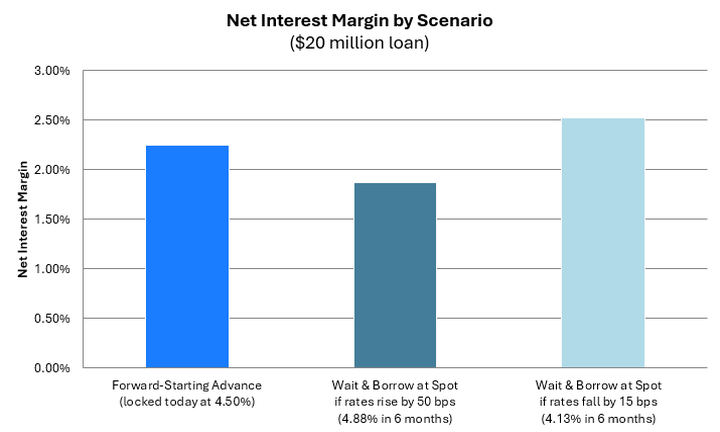
Locking in a forward-starting advance eliminates the possibility of a 38-basis point (or $76K annually) NIM compression should rates move against the member bank. Rather than betting on future rate moves, a lender is focusing on protecting its margin once the loan rate to the customer has been locked.
Wholesale Leverage and Investment Portfolio Match-Funding
Members that run a leveraged securities strategy — purchasing agency MBS, agency bonds, or other investment assets funded with wholesale borrowing — are managing a spread between an asset yield and a funding cost, usually with an intent to hold the position for a defined average life. If the bond purchase is agreed today but settles in the future, or if the member wants to lock the funding leg before executing the purchase, a forward-starting advance matched to the settlement date removes the risk that funding costs move against the trade before it is fully in place.
Illustrative example
An insurance company member agrees to purchase a $30 million agency MBS pool at a 5.50% yield, settling in 45 days. To lock the spread, the Bank executes a 45-day forward-starting advance, matched to the position's 3-year average life, at 4.50%.
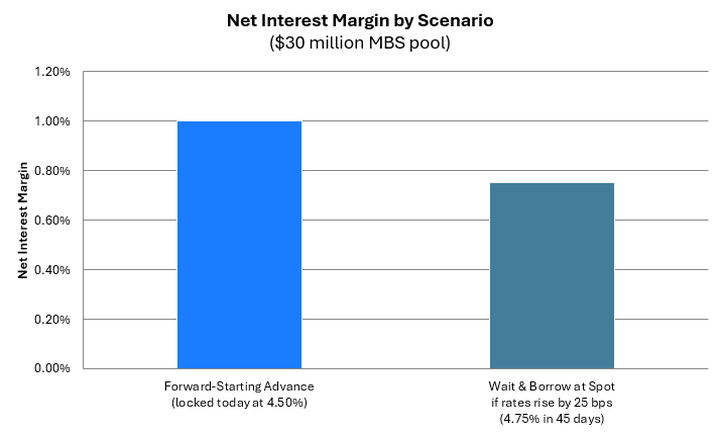
An unhedged 25 basis point increase in funding cost would compress the net interest margin by the same amount ($75K annually) before the MBS trade is settled. For a leveraged strategy where the spread itself is the entire economic value proposition for the trade, that is a substantial share of the expected return to leave exposed to an adverse funding-cost move over a short 45-day period.
The forward-starting feature can provide certainty around future funding. To learn more how to make the feature work for your organization, please contact your Relationship Manager or the Member Services Desk at (415) 616-2500.
FHLBank San Francisco makes a portion of its net income available through grants to finance the purchase, construction, or rehabilitation of housing for low- or moderate-income households in member communities. Utilizing FHLBank San Francisco products to help manage your balance sheet during change could result in more financing available for housing needs in your communities.